No Direct Response Exchange
Only the challenge and generated share information are communicated.
We develop low-overhead authentication methods that combine physically unclonable functions with secret sharing to improve resistance against machine-learning attacks without substantially increasing circuit size.
Challenge–response authentication is a widely used lightweight authentication method for devices equipped with physically unclonable functions (PUFs). Before deployment, challenge and response pairs (CRPs) generated by the PUF are stored in a database. During authentication, a challenge is sent to the target device, and the resulting response is compared with the registered response.
However, an attacker can collect many CRPs and use them as training data for a machine-learning model. Such modeling attacks can reproduce the input–output behavior of a PUF and undermine its authentication function.
Several countermeasure PUFs have been proposed, but they usually require more complex circuit structures than conventional PUFs. This additional hardware cost is problematic for embedded and IoT devices with strict resource constraints.
This research proposes a PUF authentication method that improves resistance against machine-learning attacks while limiting implementation overhead. Instead of directly communicating the PUF response, the method treats the response as secret information and generates secret shares for authentication.
Unlike conventional challenge–response authentication, the proposed method does not directly communicate a PUF response between the user device and the database. The PUF response is treated as the secret in a secret-sharing scheme, and share information is generated from it.
The generated shares are used during authentication instead of transmitting the original response. Since a single share cannot reconstruct the secret response, an attacker observing the communication cannot directly obtain the CRP information required for conventional modeling attacks.
Previous research has evaluated the entropy of PUF responses using the NIST SP 800-22 test suite and has shown that PUF outputs can provide sufficient randomness for this type of construction.
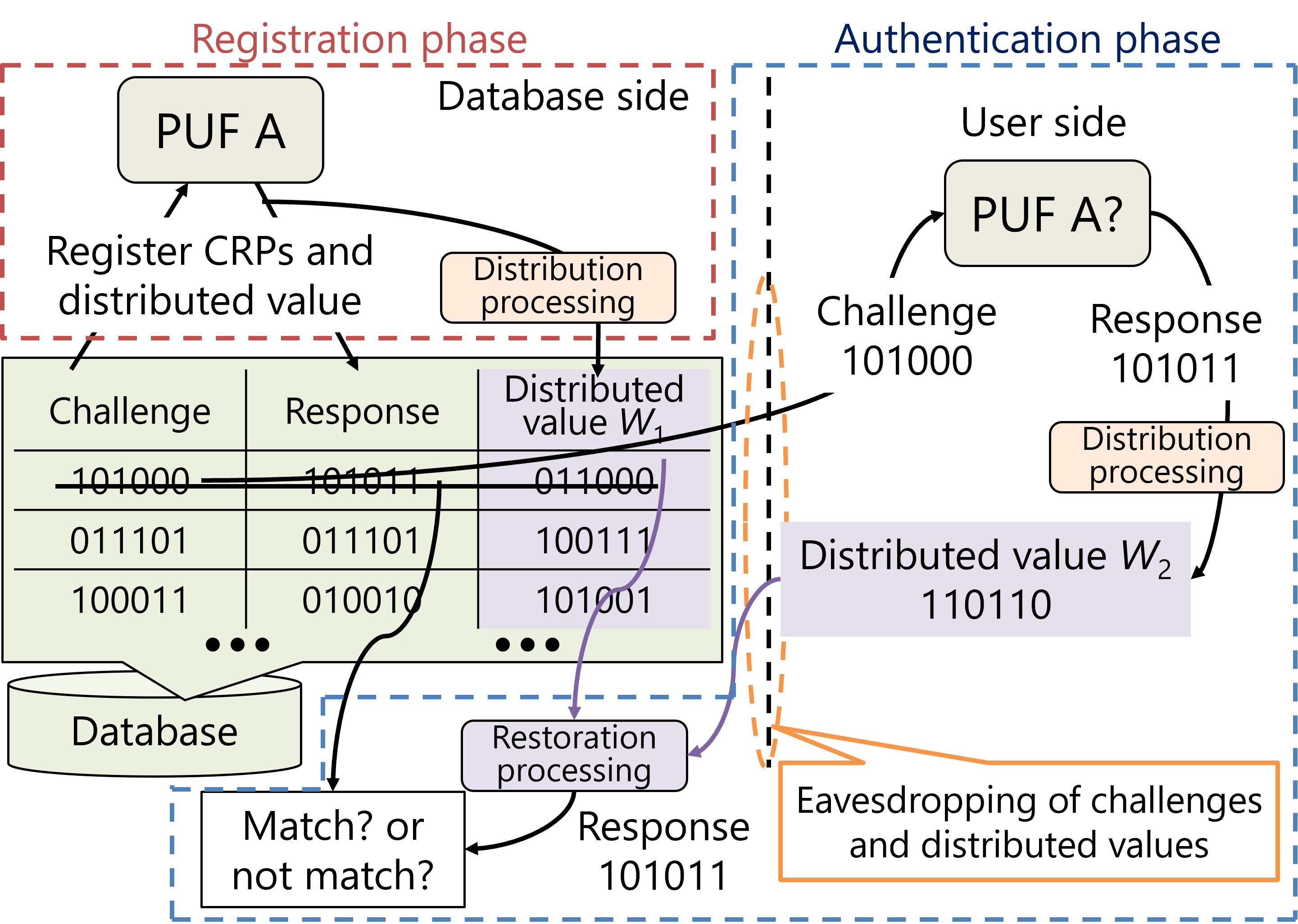
Only the challenge and generated share information are communicated.
The method avoids the large circuit expansion required by many countermeasure PUFs.
Attackers cannot reconstruct the PUF response from a single observed share.
During registration, the PUF response is used as secret information in the secret-sharing process. The method generates share information from that response.
The database stores the PUF challenge, the original response, and the generated share information. The response remains available only on the trusted database side and is not directly transmitted during normal authentication.
Since the communication contains only the challenge and share information, the PUF response itself is never directly exposed. Furthermore, one share alone is insufficient to reconstruct the response, which reduces the information available to a machine-learning attacker.
The security of the proposed method was evaluated using machine-learning attacks. The horizontal axis in Figure 2 represents the number of training samples, while the vertical axis represents the prediction rate for PUF responses or share data.
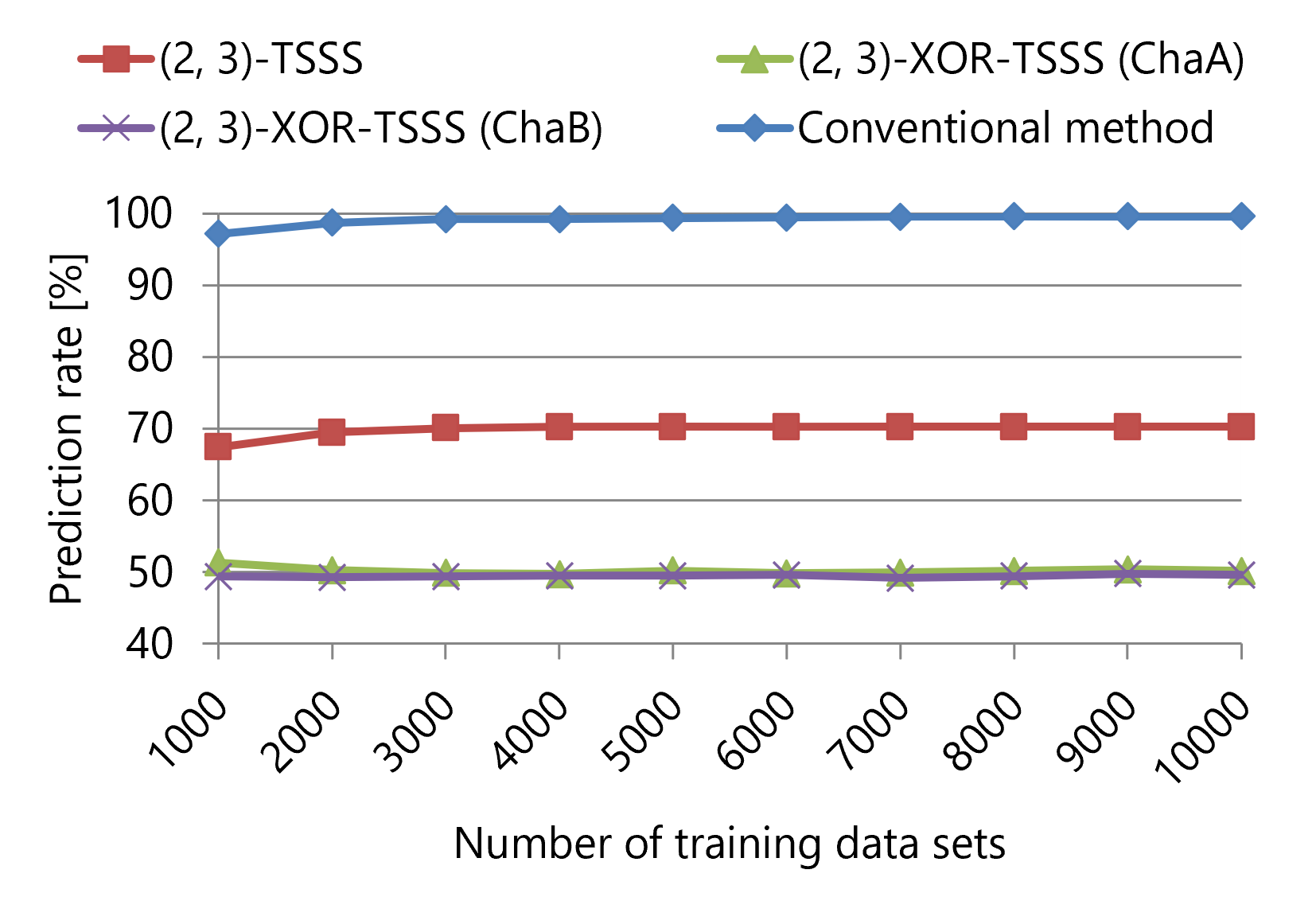
In conventional challenge–response authentication, the attacker successfully predicted more than 99% of the PUF responses. This confirms that direct CRP exchange is highly vulnerable to machine-learning attacks.
In contrast, both proposed methods—(2, 3)-TSSS and (2, 3)-XOR-TSSS—substantially reduced the prediction rate. The maximum rate observed for (2, 3)-TSSS was approximately 70%.
This 70% value was caused by an imbalance in the generated share bits: one binary value appeared with a probability of about 70%. Therefore, even an attacker that always predicted the same bit could achieve this apparent prediction rate without learning the true PUF behavior.
PUF responses can contain up to roughly 10% unstable bits because of temperature or supply-voltage variation. Authentication systems therefore commonly tolerate errors or apply error correction. From an attacker’s perspective, a prediction rate of approximately 90% or more would be required to pass such authentication. Since the proposed methods achieved at most 70%, they provide meaningful resistance against the evaluated machine-learning attacks.
The proposed method was implemented on a SASEBO-GII FPGA evaluation board using a Xilinx Virtex-5 XC5VLX30 device. A 2-XOR arbiter PUF was also implemented as a conventional countermeasure PUF for comparison.
Fuzzy extractors are commonly used to correct unstable PUF responses. The evaluation therefore included the hardware cost of BCH decoding based on the implementation approach reported by R. Maes and colleagues.
| Method | Component | Slices | Registers |
|---|---|---|---|
| Proposed Method 1 (2, 3)-TSSS |
PUF Circuit | 130 | 3 |
| Adder Circuit | 12 | 0 | |
| Peripheral Circuit | 33 | 97 | |
| Error Correction | 112 | – | |
| Total | 287 | 100 | |
| Proposed Method 2 (2, 3)-XOR-TSSS |
PUF Circuit | 130 | 3 |
| Peripheral Circuit | 37 | 97 | |
| Error Correction | 112 | – | |
| Total | 279 | 100 | |
| Conventional Method 2-XOR Arbiter PUF |
PUF Circuit | 262 | 5 |
| Peripheral Circuit | 32 | 97 | |
| Error Correction | 112 | – | |
| Total | 294 | 102 |
Secret-share communication reduced prediction rates below the level needed to imitate the PUF reliably.
Both proposed implementations required fewer total slices than the conventional 2-XOR arbiter PUF.
The method improves attack resistance without relying on a substantially larger PUF structure.
The results show that secret sharing can serve as a protocol-level defense for PUF authentication. Rather than increasing the internal complexity of the PUF, the proposed method limits exposure of the response during communication.
Future work includes evaluating larger CRP datasets, additional machine-learning models, environmental variations, side-channel leakage, communication attacks, and optimized error-correction circuits for resource-constrained IoT devices.