Performance-Cloning Resistance
Copying the architecture and weight parameters is insufficient to reproduce the original model performance.
We develop complementary mechanisms for preventing unauthorized performance replication and verifying model ownership under realistic deployment conditions.
High-performance AI models require valuable training data, substantial computational resources, and specialized design expertise. Once deployed, however, their architecture, weight parameters, or functional behavior may be copied and reused without authorization.
Our research addresses two complementary threats. The first approach combines an AI model with a physically unclonable function (PUF) to prevent the replication of model performance even when all internal model information is copied. The second approach uses robust adversarial-example-based fingerprints to verify model ownership through output responses, even when cloud services apply image preprocessing.
To prevent functional cloning and enable reliable ownership verification across embedded devices, edge AI systems, and cloud-based AI services.
This method combines an AI model with a PUF so that device-specific AI models can be created even when the same circuit pattern and the same model weights are used. We assume a strong attack scenario in which an adversary can completely copy all information stored in the model, including its architecture and weight parameters.
| Approach | Attack Phase | Attack Target | Attacker Assumption | Protection Objective |
|---|---|---|---|---|
| Proposed Method | Inference | AI model | All model information is available | Prevent replication of model performance |
| Conventional Countermeasures | Inference | AI model | Only input-output results are available | Prevent extraction or replication of model information |
Conventional defenses against model extraction attacks mainly aim to prevent reconstruction of model information from input-output observations. In contrast, our method assumes that the attacker may already possess all model information. It therefore prevents the attacker from reproducing the original model performance on another device.
The complete model consists of ordinary inference layers and a PUF-based layer. A PUF layer with the same size as a selected inference layer is inserted into the network and controls the network output according to responses generated by the device-specific PUF.
Because PUF responses differ across physical devices, different neurons are selected during inference on each device. Consequently, even a copied model with exactly the same architecture and weights cannot reproduce the same behavior without the original PUF. The effective inference behavior and learned parameters become tied to the original device.
Copying the architecture and weight parameters is insufficient to reproduce the original model performance.
Input-dependent responses make the PUF layer difficult to imitate only from observed model inputs and outputs.
The integrated PUF can support model authentication and the detection of counterfeit or impersonating AI systems.
DNN ownership verification methods include watermarking approaches that embed information into model weights and black-box approaches that use model responses to selected inputs. Adversarial examples (AEs) can also serve as model fingerprints by producing a model-specific output probability distribution.
AE-based fingerprints require only a small number of queries and can be used without direct access to internal model weights.
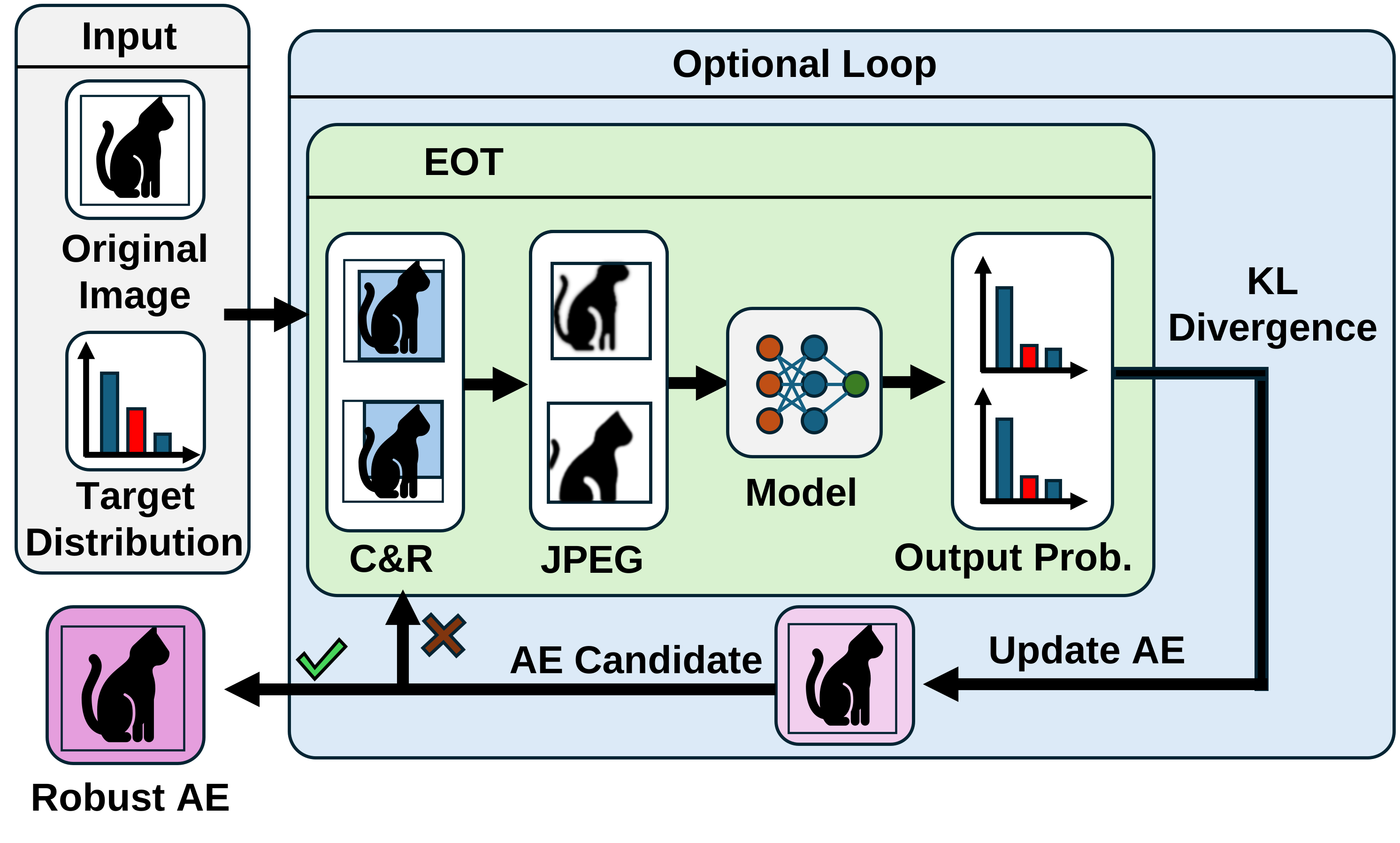
Cloud services may crop and resize input images or apply JPEG compression before inference. Since AE perturbations are very small, these transformations can alter their structure and destroy the output-distribution control required for fingerprinting. A practical fingerprint must therefore preserve its response both before and after preprocessing.
Let x be an input image and x' an adversarial example obtained by adding a small perturbation δ. The perturbation is optimized so that the output distribution of the target model f approaches a predefined target distribution y*.
The target distribution assigns a high probability to the true class ctrue and a controlled probability to a predefined target class ctarget. This retains the correct class while producing a model-specific probability response.
The generated AE should produce a distribution close to y* on the target model, whereas unrelated models are less likely to produce the same pattern. Ownership is verified by measuring the similarity between the observed and target distributions.
Expectation over Transformation (EOT) is introduced during AE generation. Multiple combinations of cropping/resizing ratios and JPEG quality levels are considered, while the loss for the untransformed input is optimized simultaneously. This preserves the fingerprint response before and after combined preprocessing.
Verification is possible without accessing internal model parameters.
A small number of carefully generated fingerprints can confirm model-specific responses.
The fingerprints remain effective under combined cropping, resizing, and JPEG compression.