We investigate poisoning attacks that exploit the intermediate representations
exchanged in split federated learning and develop an evaluation framework for
safer real-world deployment.
Overview
Split Federated Learning (SFL) has attracted attention as an efficient machine
learning framework for securely using data that may contain personal or
confidential information. In SFL, multiple clients and a server collaboratively
train a model while dividing the model computation between them. This structure
supports parallel and distributed learning without requiring clients to directly
share their original data.
However, SFL exchanges intermediate representations, often called smashed data,
during training. This characteristic creates security threats that differ from
those in conventional centralized learning. In particular, poisoning attacks
that inject malicious perturbations into the training process can seriously
reduce the accuracy and reliability of the resulting model.
This research proposes two poisoning attacks against intermediate representations.
The first continuously accumulates loss gradients and uses the accumulated value
as a perturbation. The second combines this accumulated-gradient attack with a
dataset-based perturbation, representing a more practical hybrid threat. By
evaluating these attacks, we aim to clarify long-term vulnerabilities in SFL and
provide guidance for designing effective defenses.
SFL relies on intermediate representations exchanged between clients and
the server. An attacker who manipulates these representations can influence
learning without directly modifying the original training data.
Training-Time Poisoning
Malicious perturbations injected during training can degrade model accuracy,
destabilize optimization, or create behavior that is difficult to detect from
the final model alone.
Long-Term Attack Effects
A practical security evaluation must determine whether an attack remains
effective across many epochs rather than only causing a temporary decrease
in performance.
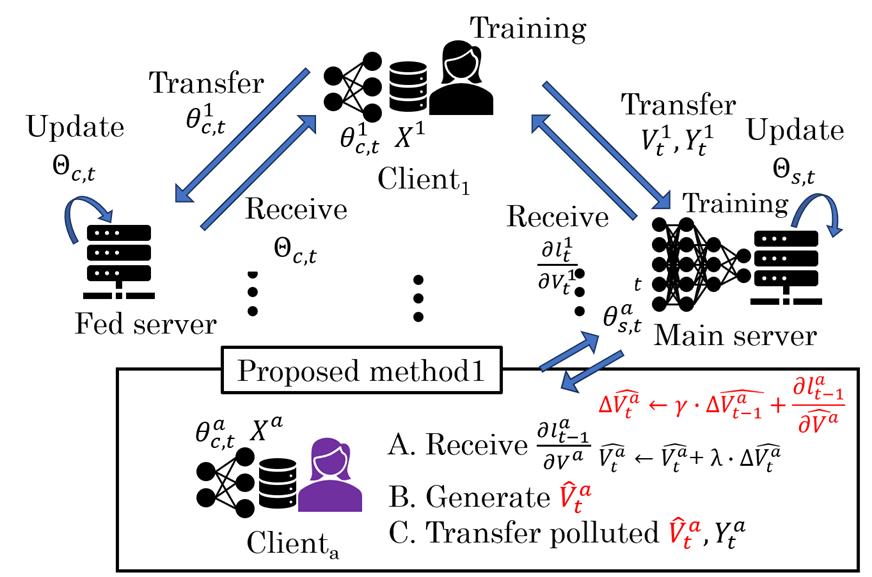
Smash Poisoning (SP) is an attack designed specifically for SFL. Conventional
SP adds the loss gradient of an intermediate representation as a perturbation
to the smashed data and thereby reduces model performance.
Our first method, called Accumulated-Gradient Smash Poisoning,
continuously accumulates the loss gradients of intermediate representations
over the course of training. The accumulated gradient is then used to generate
the perturbation applied to the current intermediate representation.
Figure 1. Overview of Accumulated-Gradient Smash Poisoning.
Difference from Conventional Smash Poisoning
Conventional SP uses the gradient calculated at the current training step. Its
effect may therefore weaken as learning progresses and the model adapts to the
injected perturbation. In contrast, the proposed method retains information from
previous gradients. This allows the perturbation to reflect the training history
and maintain its influence even in later epochs.
Key Contribution
By accumulating gradients across training, the method provides a framework for
evaluating persistent poisoning effects that arise from the repeated exchange
of intermediate representations in SFL.
Attack Process for evaluation of vulnerability
The client and server perform ordinary forward propagation up to the split layer.
The attacker recieves the loss gradient with respect to the intermediate representation.
The current gradient is added to the gradients accumulated in previous training steps.
A perturbation is generated from the accumulated gradient and added to the intermediate representation.
The poisoned representation is used in the subsequent forward and backward computations.
Training-History Awareness
The perturbation incorporates information from gradients generated in previous epochs.
Persistent Influence
The attack is designed to avoid the rapid decay in effectiveness observed with conventional SP.
SFL-Specific Evaluation
The method exploits the repeated transmission of intermediate representations between clients and the server.
The second method is a hybrid poisoning attack that replaces the conventional
SP component in a dataset-based poisoning framework with the accumulated-gradient
attack proposed in Method 1. It simultaneously introduces perturbations through
the input space and through the intermediate representations exchanged during SFL.
Hybrid Threat Model
An attacker may be able to manipulate part of the training dataset while also
interfering with the intermediate representations generated during collaborative
learning. This combined scenario is more realistic than assuming that the attacker
can operate through only one attack path.
The dataset-side perturbation changes the inputs used for learning, while the
accumulated-gradient perturbation continuously contaminates the intermediate
representations. Their combined effect can influence both the input space and the
optimization process.
Security Significance
Evaluating this hybrid attack makes it possible to analyze interactions between
multiple poisoning mechanisms. The results can reveal whether the two components
strengthen each other, whether their effects persist over time, and which parts of
the SFL pipeline require defensive monitoring.
Input-Space Manipulation
Dataset-based perturbations influence the samples supplied to the local learning process.
Representation-Space Manipulation
Accumulated loss gradients contaminate the smashed data exchanged between the client and server.
Combined Impact Analysis
The method supports evaluation of compound threats that may occur in practical SFL environments.
Evaluation Perspective
The proposed attacks can be evaluated by measuring clean-model accuracy,
poisoned-model accuracy, accuracy degradation across epochs, convergence behavior,
and the persistence of attack effects. Comparing conventional SP, Method 1, and
Method 2 makes it possible to identify when gradient accumulation and hybrid
poisoning create additional risk.
These findings can guide defenses such as anomaly detection for intermediate
representations, gradient-history monitoring, robust aggregation, client
authentication, and validation of local training data.
C. Ishida, R. Kumagai, S. Takemoto, Y. Nozaki, and M. Yoshikawa, "Security Evaluation of Dataset-aware Cumulative Gradient Smash Poisoning Method in Split Federated Learning," Proc. of the 31st International Symposium on Artificial Life and Robotics 2026, pp. 989–994, 2026.
C. Ishida, R. Kumagai, S. Takemoto, Y. Nozaki, and M. Yoshikawa, "Hybrid Targeted Poisoning in Split Federated Learning and its Security Evaluation,"IEICE Technical Report, vol. 125, no. 356, IE2025-70, pp. 89-94, 2026.
C. Ishida, R. Kumagai, S. Takemoto, Y. Nozaki, and M. Yoshikawa, "Dataset-driven Cumulative Gradient Smash Poisoning in Split Federated Learning and its Evaluation", IPSJ SIG Technical Report, vol. 2026-AL-206,no. 11,pp. 1–8,2026.